Six RCDSO Case Files—and the ODA Board Wants to Make Dr. Edward Busvek President-Elect?
There are moments when members of an organization should stop being polite and start demanding answers.
This is one of those moments.
The Ontario Dental Association Board of Directors is preparing to consider the ratification of its current Vice-President, Dr. Edward Busvek, as President-Elect—putting him on the path to becoming President and one of the most visible representatives of Ontario’s dental profession.
But publicly available information obtained from the Royal College of Dental Surgeons of Ontario identifies SIX separate regulatory case files involving Dr. Busvek, with decisions spanning 2021 to 2023.
Six.
And ODA members should be asking an obvious question:
How can the Board possibly contemplate making this ratification a routine promotion without first providing members with a serious explanation of how it assessed this regulatory history?
This isn’t gossip. It isn’t innuendo. And it isn’t a personal vendetta.
It is information contained in the public regulatory record of our profession.
Read What Our Own Regulator Said
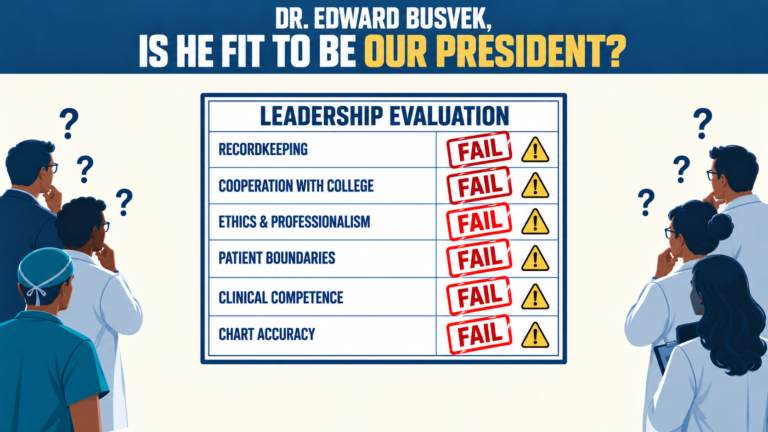
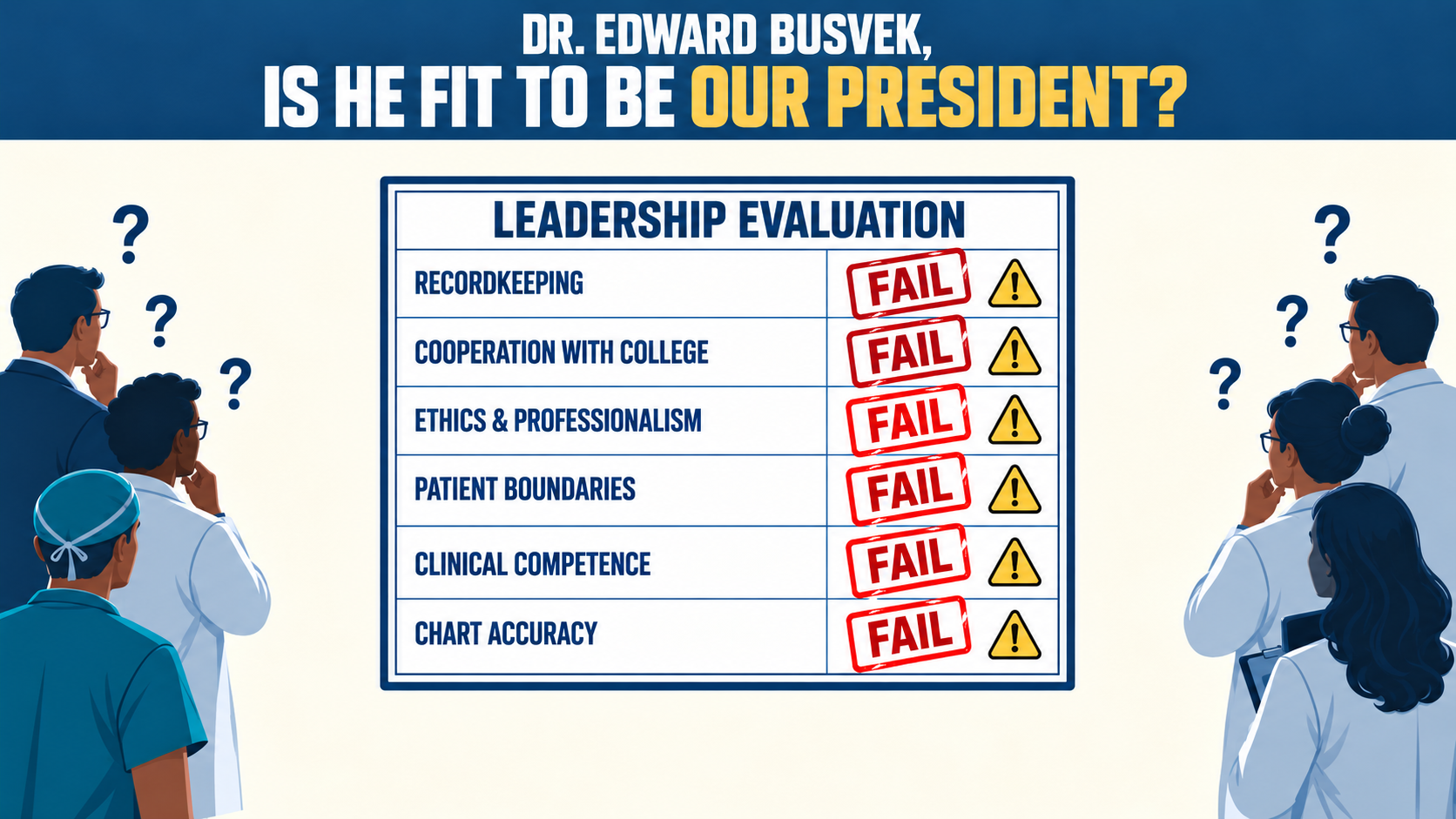
One RCDSO decision cautioned Dr. Busvek regarding his professional, legal and ethical responsibility to maintain complete patient records.
But it didn’t stop there.
The College stated that his “lack of compliance with the College’s repeated requests for records hindered the College’s ability to properly investigate a patient complaint.”
Think about that.
Our professional regulator says that repeated requests for records were not complied with and that this hindered its investigation of a patient’s complaint.
The same decision went further.
The RCDSO cautioned Dr. Busvek regarding an “inaccurate transcription of patient chart notes” upon which he relied in responding to the complaint. The regulator expressly reminded him that his communications with the College must be truthful and accurate.
And now the ODA Board is considering elevating him to President-Elect?
ODA members have every right to be deeply concerned.
And It Wasn’t Just One Case
If this were one isolated historical regulatory matter followed by years without further regulatory intervention, members might reasonably view it differently.
But that isn’t the record before us.
Another 2021 case again involved cautions concerning recordkeeping and cooperation with the College. Once again, the RCDSO stated that lack of compliance with its repeated requests for records hindered its investigation. That matter required education in recordkeeping and restorative dentistry followed by 24 months of practice monitoring.
A third case again resulted in cautions concerning recordkeeping and cooperation with the College, together with further education and 24 months of practice monitoring.
Then another case resulted in a required two-day course in Ethics and Professionalism, again followed by 24 months of practice monitoring.
At what point does an organization’s leadership stop looking at each regulatory file in isolation and start asking about the cumulative record?
Surely six case files warrant that question.
Then Come the Boundary-Related Cases
The 2023 regulatory outcomes should make every director contemplating this ratification pay very close attention.
In one case, the RCDSO required Dr. Busvek to undertake a one-on-one course in ethics, boundaries and communication covering release and transfer of records, establishing and maintaining appropriate boundaries in the dentist-patient relationship, and communications with the College.
Another 2023 case required another one-on-one course addressing ethics, boundaries and communication, including maintaining appropriate dentist-patient boundaries and cooperation with a College investigation. It also required extensive one-on-one restorative-dentistry education and 24 months of practice monitoring.
Let us be absolutely clear about what we are—and are not—saying.
The material reviewed here does not establish a finding that Dr. Busvek sexually abused a patient. No responsible publication should claim that it does.
But members should not be expected to shrug their shoulders when their regulator required a prospective ODA President to undergo individualized education concerning ethics, boundaries and communication.
That deserves scrutiny.
Serious scrutiny.
The RCDSO Itself Tells Us Why Boundaries Matter
The RCDSO’s current Standard of Practice: Prevention of Boundary Violations and Sexual Abuse describes its Standards as establishing the legal, professional and ethical obligations applying to Ontario dentists and as protecting the public by communicating the College’s expectations of the profession.
The RCDSO defines a boundary violation as crossing the limits of a safe and effective dentist-patient relationship. It emphasizes that violations can occur intentionally or unintentionally and recognizes the inherent power imbalance between dentist and patient.
Its current Standard also prohibits inappropriate comments that could reasonably cause offence, undermine trust in the dentist or the profession, or make a patient uncomfortable or feel discriminated against.
The Standard was approved in 2025 and should not be retroactively treated as governing earlier proceedings. But it tells us unmistakably how seriously our regulator regards professional boundaries, patient trust and professional communication.
Yet the individual the ODA Board is contemplating promoting to President-Elect has a public regulatory history that includes mandated one-on-one education in ethics, boundaries and communication.
How can members reasonably be expected not to ask questions?
Since When Is Being Licensed Enough to Become ODA President?
Perhaps the most disturbing aspect of this situation is the apparent confusion between two completely different standards.
Nobody here is deciding whether Dr. Busvek should practise dentistry.
The RCDSO regulates dentists. The ODA chooses its leaders.
Those are profoundly different questions.
The relevant question isn’t:
“Is Dr. Busvek legally entitled to practise dentistry?”
It is:
“Is Dr. Busvek the person the Ontario Dental Association should deliberately choose to represent more than 12,000 Ontario dentists as its future President?”
Leadership is not an entitlement.
President-Elect is not a participation award.
And succession through the ODA executive should never become an automatic conveyor belt in which yesterday’s Vice-President simply becomes tomorrow’s President-Elect regardless of information directors ought to consider.
If anything, the standards for someone representing our entire profession should be higher, not lower.
Imagine Explaining This to the Minister of Health
ODA leaders routinely ask politicians, civil servants and policymakers to trust us.
We tell government that dentists are highly trained professionals capable of self-regulation.
We advocate about patient care.
We discuss public dental programs.
We argue for professional autonomy.
We ask government to respect the judgment and integrity of our profession.
Now imagine an ODA President sitting across the table from the Minister of Health or senior Ministry officials after somebody in that office performs a basic public-register search.
What exactly is the ODA supposed to say when asked about this regulatory history?
More importantly:
Why would the ODA voluntarily place itself in that position?
The Association’s credibility is an asset belonging to every member—not something a Board should gamble with casually.
What Did the Board Know—and When Did It Know It?
Before any ratification occurs, ODA members deserve answers.
- Did every director know about these six regulatory case files?
- Did the Governance and Nominating Committee review the complete public RCDSO record including going through the RCDSO’s publications such as The Dispatch where details of such complaints are shared. In particular did ALL DIRECTORS review the MULTIPLE BOUNDARY VIOLATIONS of concern
- Were directors specifically informed about the cautions concerning cooperation with the College?
- Were they informed about the inaccurate transcription of chart notes identified by the regulator?
- Were they informed about the ethics and professionalism education?
- Were they informed about the one-on-one education involving professional boundaries?
- Were they informed about the repeated 24-month monitoring requirements?
- Did anyone undertake a formal reputational-risk assessment?
- Did anyone ask how this would look to members AND to:
- Patients?
- GOVERNMENT?
- THE MEDIA?
Or was everybody simply expected to raise their hands and ratify?
Completion of Remediation Does Not Make the History Disappear
Fairness requires acknowledging that the RCDSO record identifies the disclosed cautions, educational requirements and monitoring as completed.
That matters.
People deserve the opportunity to learn, improve and rehabilitate their professional standing.
But there is an enormous difference between saying:
“A dentist completed the remediation required by his regulator”
and saying:
“Therefore the ODA should make him its next President.”
One does not automatically follow from the other.
And pretending that completed remediation makes the underlying regulatory history irrelevant would make the ratification vote meaningless.
The Ratification Vote is a Governance safety measure that the ODA has in place to assist directors in deciding if Dr. Busvek remains suitable to advance to the office of President-Elect and ultimately President.
This Is Now a Test of the Board’s Own Governance Standards
Ultimately, this issue is bigger than one individual.
It is a test of the ODA Board itself.
- What does this Board consider acceptable for the highest leadership positions in our Association?
- What due diligence does it conduct?
- What does “professionalism” mean when the issue concerns its own leadership?
- What value does it place on public confidence?
- And will directors exercise independent judgment—or simply approve the next person in the succession line?
Every director voting on this ratification should understand something very clearly:
This information is PUBLIC on the RCDSO’s own website, for everyone to see.
The document itself states that the information was obtained from the RCDSO register which means:
- Members can find it.
- Patients can find it.
- Journalists can find it.
- Politicians can find it.
- Government officials can find it.
And once Dr. Busvek becomes President-Elect, the question will no longer simply be about his regulatory history.
The question will be why the ODA Board knew—or should have known—about that history and nevertheless decided that he was the appropriate person to become the public face of Ontario dentistry.
Members Should Demand Answers Before the Vote
If there is important context that changes the picture, tell us.
If the Board conducted comprehensive due diligence, show us that it did.
If directors believe the completed remediation and subsequent professional record outweigh these concerns, explain their reasoning.
But do not ask Ontario dentists to accept a ratification of this importance on faith.
And do not dismiss legitimate questions about a publicly available regulatory record as negativity, disruption or disloyalty.
Accountability is not disloyalty.
Accountability is a test of Good Governance
Accountability strengthens the ODA. It is NOT an “attack on the ODA”
Asking questions is not misconduct.
It is precisely what an effective Board should be doing itself.
Before casting a vote, every ODA director should therefore ask one uncomfortable question:
If these six RCDSO case files were on the front page of tomorrow’s newspaper, would I be prepared to look Ontario’s dentists, patients and Minister of Health in the eye and explain why I voted to make Dr. Edward Busvek our President-Elect?
If the answer is yes, then explain why.
If the answer is no, vote no.
And if directors do not yet know enough to answer that question, there is only one responsible course:
Do not ratify until you do.