A former ODA President who questioned another professional’s conflict of interest now faces questions about his own conduct toward a female Board member. What does this reveal about accountability and the treatment of dissent within the ODA?
The conduct of Board member and Past President, Dr. Arthur Worth, has raised troubling questions about governance, accountability and the consistent application of professional standards at the Ontario Dental Association (ODA).
At the heart of this controversy lies a simple but fundamental question: When an influential former ODA President demands accountability from others, should he not be held to those same standards himself?
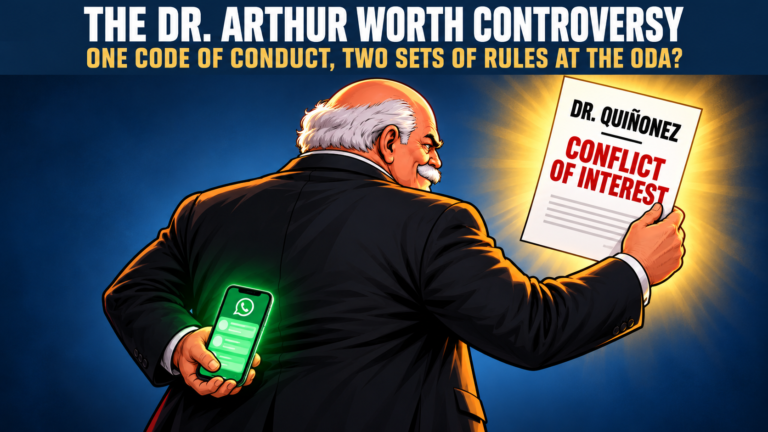
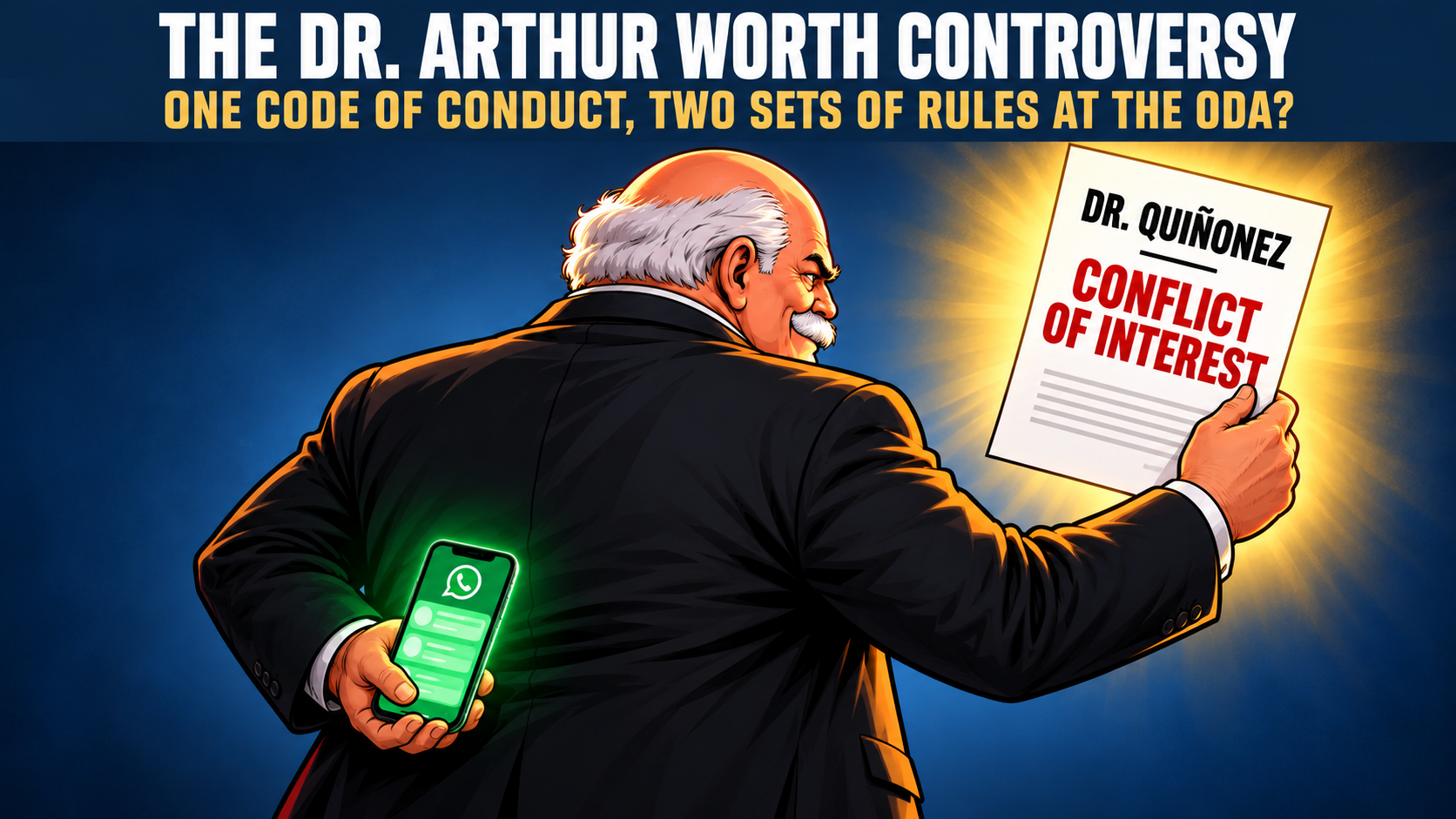
The question is particularly relevant given Dr. Worth’s previous criticism of Dr. Carlos Quiñonez, former Editor of the ODA’s Ontario Dentist journal, and the more recent emergence of WhatsApp messages attributed to Dr. Worth containing disparaging remarks about a fellow Board member, Dr. Nafisa Ahmad.
The documentary evidence raises questions not only about the conduct of an individual director, but also about the culture of leadership and accountability within the ODA.
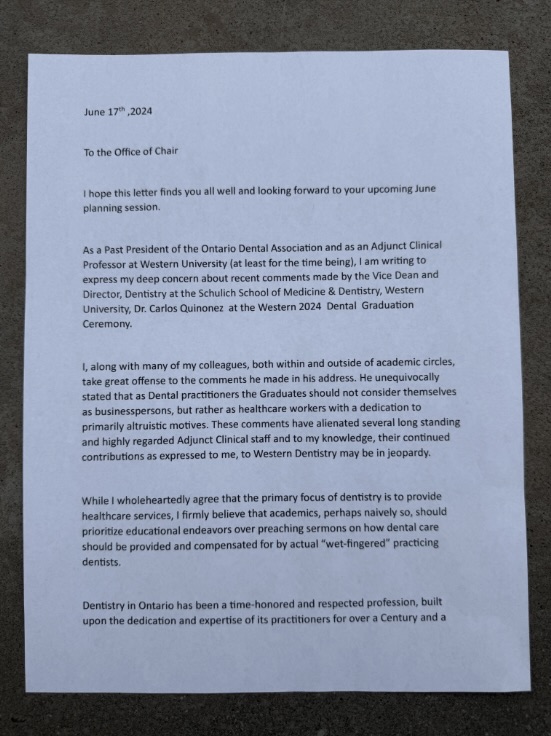
“The Fox in the Henhouse” Dr. Worth’s 2024 letter to ODA Office of the Chair:
Dr. Arthur Worth was the original founder of the movement which claimed that Dr. Carlos Quiñonez, who as acting Dean at the Schulich School of Dentistry at Western University, was in a conflict of interest by advocating for socialized dentistry, but at the same time being the Editor of the ODA’s Ontario Dentist Journal. Dr. Arthur Worth was instrumental in the movement to have Dr. Quiñonez resign as Editor.
In the Spring of 2025, Dr. Arthur Worth went on to be elected to the current Board of Directors and encouraged others to run as well.
On June 17, 2024, Dr. Arthur Worth, writing as a Past President of the ODA and an Adjunct Clinical Professor at Western University, addressed a three-page letter to the ODA Office of the Chair.
In that letter, Dr. Worth expressed serious concerns about statements made by Dr. Carlos Quiñonez, then Vice Dean and Director of Dentistry at Western University’s Schulich School of Medicine & Dentistry, during the university’s 2024 dental graduation ceremony.
Dr. Worth objected to remarks he understood as suggesting that graduating dentists should not consider themselves businesspeople, but rather healthcare workers motivated primarily by altruism.
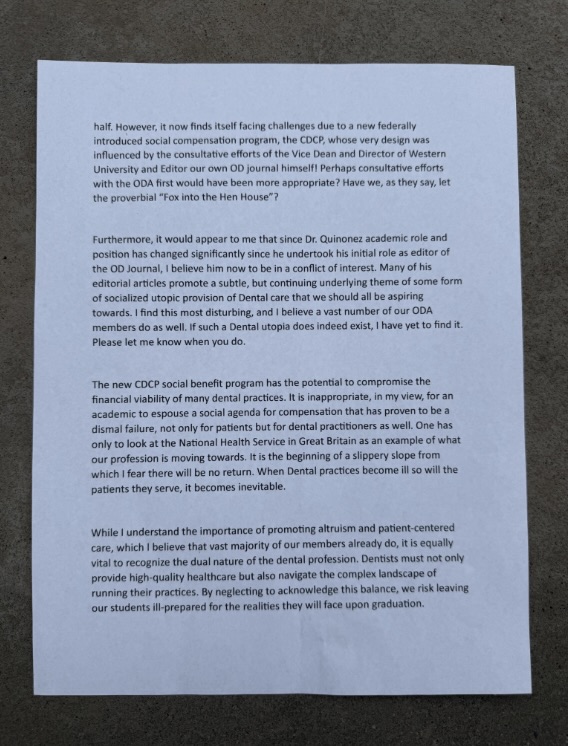
He argued that such views failed to adequately recognize the economic realities of practicing dentistry, including rising overhead, the financial sustainability of dental practices and the importance of preparing graduates for the business responsibilities of their profession.
He expressed concern about the potential consequences of government-funded dental programs for the financial viability of private practices.
Dr. Worth warned that the CDCP could compromise the financial sustainability of dental practices and drew comparisons with the United Kingdom’s National Health Service.
Dr. Worth also questioned Dr. Quiñonez’s involvement in the development of the Canadian Dental Care Plan (CDCP), particularly given his simultaneous position as Editor of the ODA’s Ontario Dentist journal.
In his letter, Dr. Worth explicitly stated:
“Dr. Quiñonez academic role and position has changed significantly since he undertook his initial role as editor of the OD Journal. I believe him now to be in a conflict of interest. Many of his editorial articles promote a subtle, but continuing underlying theme of some form of socialized utopic provision of Dental care that we should all be aspiring towards. I find this most disturbing, and I believe a vast number of our ODA members do as well. If such a Dental utopia does indeed exist, I have yet to find it. Please let me know when you do.”
This was brought forward at the November 2024 General Council meeting asking Dr. Quiñonez to disclose his generously paid consulting work with the federal government, to help create the CDCP. As simple as it would have been to simply declare his conflict of interest; Dr. Quiñonez refused. Subsequently to this meeting, Dr. Quiñonez resigned his editorship of The Ontario Dentist.
The “Social Contract:” How it Affects Our Future Colleagues
Dr. Worth’s observations are not inaccurate, as it has been rumoured that now Dr. Quiñonez has applied to become Dean of Dentistry at the University of Toronto.
We wonder how students would feel when they are paying thousands of dollars for their livelihood education to be instructed by a Dean that advocated for their potential earnings in dental reimbursements to be “20% less,” or that they should consider a more altruistic provision of services, being bound by the concept of a “social contract,” promoted by Dr. Quiñonez, in his presentations to the RCDSO, the RCDC and at the ODA ASM.
Dental students work hard to pay for an education that they hope will afford them with financial reimbursement necessary to meeting the increasing cost of practice overhead, paying down student loans, while eventually hoping for enough money to pursue the increasingly distant dream of practice ownership, and for a comfortable standard of living. That is one, among many reasons why they chose to enter the profession. We wonder how they would feel knowing that their Dean advocated for a socialized dental plan that has severely impacted their practical clinical training, with patients not coming to the dental school clinics like before, and undermines their ability to earn a fair wage for all the years of education they have painstakingly lived through and paid for.
Whatever one’s position on Dr. Quiñonez’s policy views, the underlying principle advanced at the time was straightforward:
ODA leaders and representatives should be accountable for conduct or interests that may conflict with their responsibilities to the Association and its members.
That is a legitimate governance principle. But that principle must apply equally to everyone.
And that brings us to Dr. Worth’s own conduct.
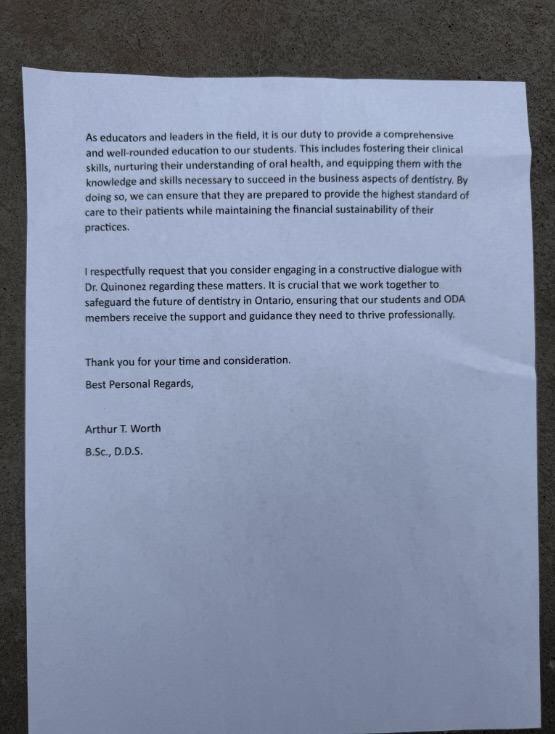
Documentary Exhibit 1: Dr. Worth’s Letter of June 17, 2024
The following are the three photographs of the letter supplied with this article, in their original page order.
Dr. Arthur Worth’s Treatment of a Fellow Board Member
Recently, serious concerns have arisen regarding Dr. Arthur Worth’s treatment of a racialized female Board member, Dr. Nafisa Ahmad.
Dr. Nafisa Ahmad has been identified as the first visibly Muslim female dentist and the first female dentist of South Asian descent elected to the ODA Board, in the Association’s 160-year history. According to her online profile, she graduated with honours, from the University of Toronto, Faculty of Dentistry in 1997.
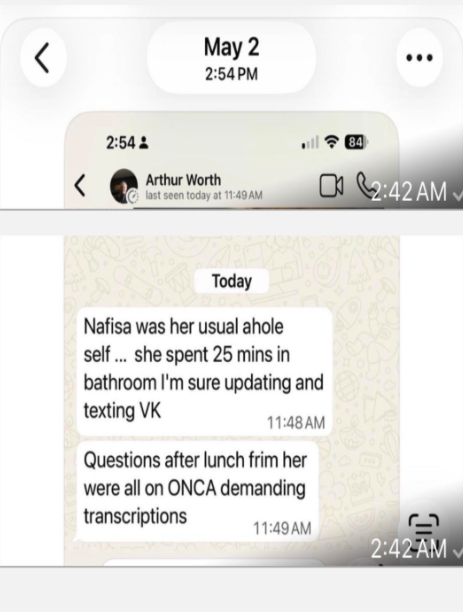
A WhatsApp screenshot provided for this article displays a conversation under the name “Arthur Worth.”
In a message timestamped 11:48 AM, Arthur Worth refers to Dr. Ahmad as her “usual ahole self.” The message also claims that she spent “25 mins in bathroom” and speculates that she was communicating with another individual.
How utterly inappropriate for a sitting male Board member, and more so, a Past ODA President, to make such disparaging and personally intrusive remarks about a female colleague.
- The language is misogynistic, offensive and disrespectful. It raises serious questions about the standards of professionalism expected of someone occupying a position of leadership within the ODA.
- But perhaps even more troubling is the reference to Dr. Ahmad’s use of the bathroom.
- How did Dr. Worth arrive at the specific figure of 25 minutes?
- Was he personally monitoring her movements at the ODA’s headquarters, or was someone else reporting them to him?
- On what basis did he speculate about her activities while she was in the bathroom, including whether she was using her cellphone or engaging in private communications, without any evidence to substantiate such allegations?
- And why was a female director’s bathroom use considered an appropriate subject of discussion among Board colleagues?
These are legitimate questions arising directly from the message.
The screenshot does not establish that surveillance occurred. However, the specificity of the comment and the speculation concerning her private activities warrant an explanation.
What kind of professional culture permits a female Board member’s bathroom use to become the subject of disparaging commentary?
The Second Message: A Revealing Connection to Governance
Perhaps the most significant aspect of the screenshot is Arthur Worth’s second WhatsApp message, timestamped 11:49 AM.
“Questions after lunch frim her were all on ONCA demanding transcriptions”
- This message refers directly to Dr. Ahmad’s questions concerning the Ontario Not-for-Profit Corporations Act (ONCA) and her requests for transcriptions.
- Why should a director’s legitimate questions about corporate governance and access to records be discussed, alongside such disparaging personal commentary?
- Directors have a responsibility to exercise independent judgment, seek appropriate information and ensure that the organization complies with its legal and governance obligations.
- Asking questions about ONCA is not misconduct. Requesting accurate records of Board proceedings should not be perceived as inherently disruptive. Challenging the interpretation or application of governance rules is not an attack on the Association.
- These are matters directly relevant to a director’s oversight responsibilities.
Yet the messages place Dr. Ahmad’s GOVERNANCE QUESTIONS alongside a PERSONAL INSULT and speculation about her BATHROOM USE. That juxtaposition is particularly troubling.
- The messages do provide a legitimate basis for questioning whether directors who insist upon proper governance procedures are being treated with hostility.
- Is a director who asks questions about ONCA and requests accurate records of proceedings considered a problem to be managed, rather than a colleague fulfilling her responsibilities?
- And is this the culture of respect and collegiality that the ODA Board of Directors expects its members to uphold?
The accompanying WhatsApp screenshot allows readers to examine the actual language for themselves.
One Code of Conduct — Or Two Sets of Rules?
The larger governance question is therefore unavoidable:
When the ODA’s own Code of Conduct is broken by someone within the favoured inner leadership circle: the “Old Boys’ Club”, does the ODA apply the same standards of accountability that its leaders have demanded of others?
Dr. Worth previously raised concerns about Dr. Quiñonez’s perceived conflict of interest and advocated for greater accountability concerning his role as Editor of Ontario Dentist.
Should a former ODA President and sitting director, not be expected to demonstrate that same commitment to professional standards in his own interactions with fellow Board members?
If the ODA expects its directors, councillors and volunteers to comply with its Code of Conduct, surely those standards must apply to everyone, regardless of seniority, influence, personal relationships or past leadership positions.
Codes of conduct have little meaning if they are enforced selectively. Selective enforcement is a tool of control.
The Association must be prepared to address legitimate concerns about the conduct of its own leadership with the same seriousness it applies to complaints involving those who challenge its leadership.
The question is not whether individuals should be condemned without a fair investigation. They should not.
The question is whether allegations involving influential members of the Board are examined independently, fairly and consistently, or whether some individuals receive preferential treatment because of their standing within the organization.
A Code of Conduct must never become a weapon against dissenting Directors, Councillors or dues-paying members, while serving as a shield for those within the leadership establishment.
Leadership Must Welcome Scrutiny, Not Punish It
An effective Board does not fear difficult questions. It does not treat disagreement as disloyalty. It does not confuse criticism of leadership with an attack on the institution.
Healthy governance requires directors who challenge assumptions, councillors who ask uncomfortable questions, members who scrutinize expenditures and leaders who are willing to explain and defend their decisions.
Yet the messages attributed to Dr. Worth raise troubling questions about the treatment of directors who insist on transparency, access to records and adherence to governance rules.
The real issue extends beyond a personal insult. It concerns the expectations of professional conduct within an organization that represents over twelve thousand Ontario dentists.
If an influential former president can question the professional responsibilities of another individual, surely members are equally entitled to question his own conduct.
If the ODA expects respect and professionalism from its members, those standards must be demonstrated by its leadership.
And if the Association invokes its Code of Conduct against individuals who challenge leadership, it must be prepared to apply that same Code fairly when concerns involve members of the leadership establishment.
Leadership must welcome scrutiny, not punish it.
“The true measure of leadership is not how we treat those who agree with us, but how we treat those who dare to disagree. Integrity is not demonstrated by the standards we impose on others, but by the standards we are willing to uphold ourselves.”
Concerned Dentists of Ontario