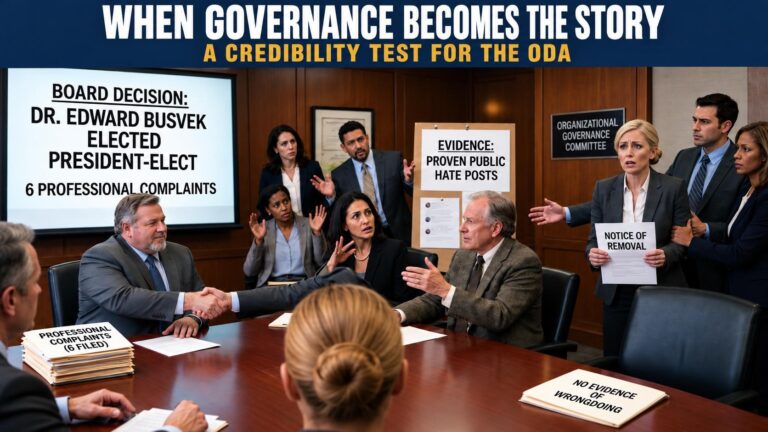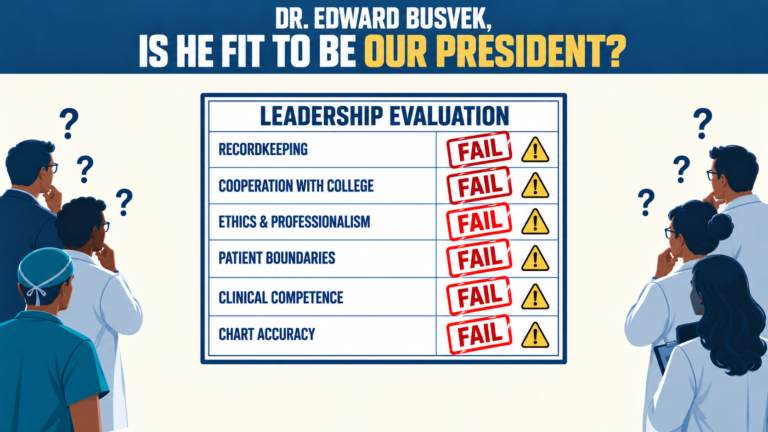
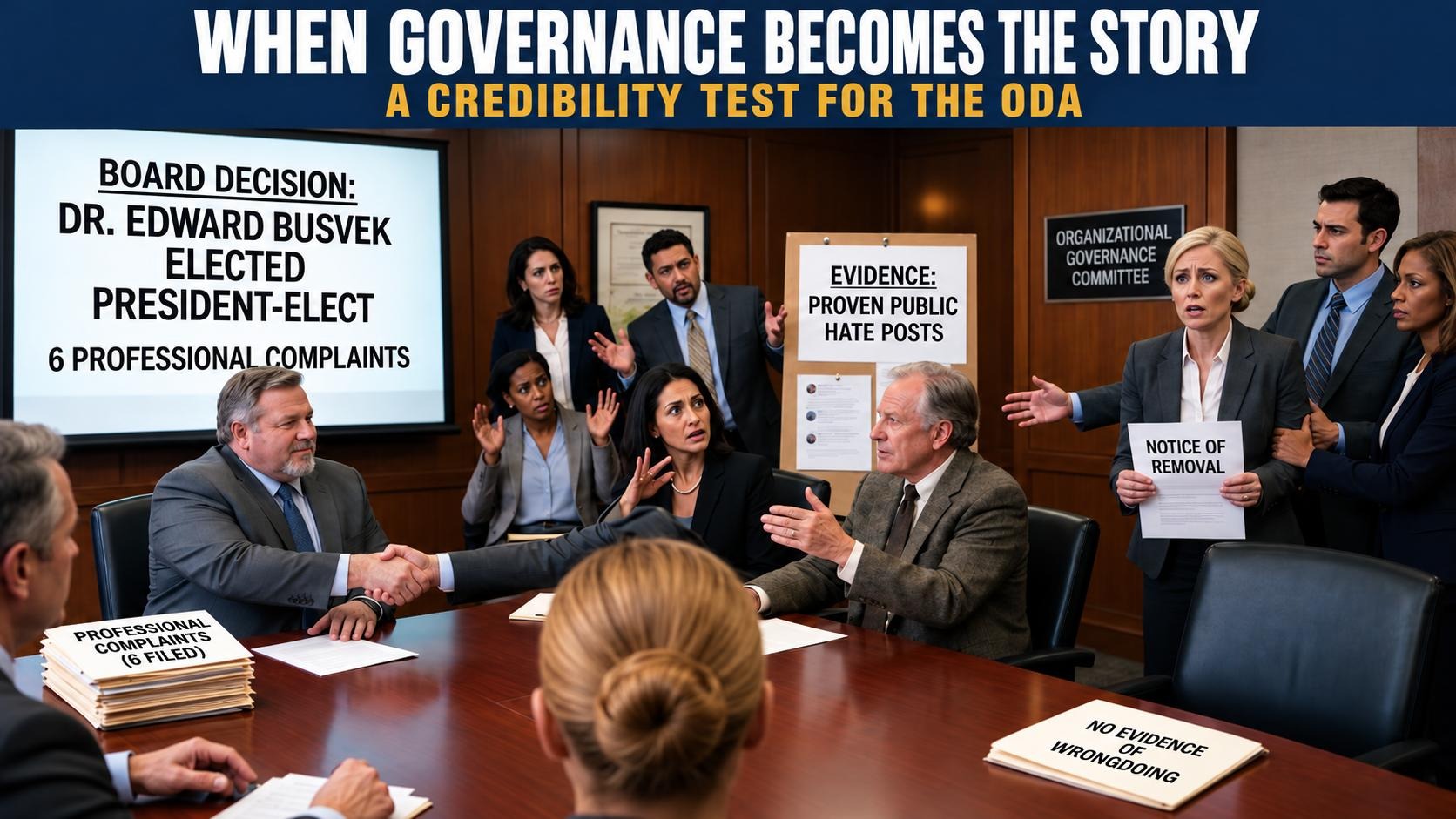
Leadership decisions involving Dr. Edward Busvek, Dr. Jonathan Mayer and Dr Laurie Houston have placed the ODA’s standards—and its ability to speak credibly for Ontario dentists—under scrutiny.
A Question Larger Than Any One Leader
Professional associations depend on a form of authority that cannot be written into a bylaw: trust. Members must trust that leaders are selected through fair and intelligible standards. Governments must trust that the organization speaks with a stable mandate. The public must trust that a body advocating for health professionals takes integrity, inclusion and accountability seriously. When leadership decisions appear inconsistent, that trust can unravel quickly.
The Ontario Dental Association currently lists Dr. Edward Busvek as President-Elect for 2026–27. This follows an earlier controversy involving Dr. Jonathan Mayer, whose social-media activity prompted an independent task-force review. In April 2026, the ODA announced that its Board had ratified Dr. Mayer as President-Elect after he accepted recommendations involving education, reflection, dialogue and an apology. Dr. Mayer later issued an apology acknowledging that his posts were offensive and did not reflect ODA values. The ODA’s current leadership page no longer lists him on the Board.
The RCDSO register provides a more precise account of Dr. Busvek’s regulatory history. It lists six complaint-and-report case files with decisions between January 2021 and November 2023. Three files—180023, 180127 and 180567, all decided January 12, 2021—resulted in cautions by the Inquiries, Complaints and Reports Committee. The cautions concerned complete, accurate and accessible patient records; retention and transfer of radiographs; and cooperation with the College’s requests during complaint investigations. In file 180023, the Committee also cautioned Dr. Busvek about an inaccurate transcription of chart notes used in his response and emphasized that communications with the College must be truthful and accurate. The register records each caution as completed.
Those three 2021 matters also produced specified continuing education or remedial requirements. Depending on the file, Dr. Busvek was required to complete courses in informed consent, recordkeeping and restorative dentistry, including instruction on removal of decay, marginal integrity and adequate contact points. Each matter included 24 months of office-visit practice monitoring following completion of the applicable courses. The register lists the courses and monitoring requirements as completed.
The other three files show remedial outcomes without a caution in the information supplied. File 190607, decided December 20, 2021, required a two-day in-person PBI Education course in ethics and professionalism and 24 months of office-visit monitoring after the course. Files 21-0668 and 21-0843, both decided November 2, 2023, required one-on-one education in ethics, boundaries and communication, including release and transfer of records, dentist-patient boundaries, and communications or cooperation with the College. File 21-0843 also required a one-on-one restorative-dentistry course covering caries diagnosis, risk assessment, radiographic prescribing and interpretation, treatment planning, preventive and minimally invasive therapies, recordkeeping and informed consent, followed by 24 months of practice monitoring. The register lists all of these requirements as completed.
Regarding Dr. Mayer’s public Facebook transgressions, General Council later convened a special meeting, deliberated for several hours and voted to remove Dr. Mayer from the Board (verified). This reveals an unusually stark institutional sequence: the Board ratified a candidate after an independent review, and the governing council then reversed the practical result. The damage lies not only in who prevailed, but in the impression that the organization lacked a shared standard before the crisis began.
The reported treatment of former director Dr. Laurie Houston sharpens the concern about inconsistent standards. According to an account published by the member-advocacy site Engage ODA, the Board called a special meeting seeking her removal, did not identify concrete evidence of wrongdoing comparable to the documented Facebook posts examined in the Mayer matter, and did not commission a comparable investigation into her alleged conduct. The account says General Council nevertheless approved her removal by a narrow margin and that the Board also sought to bar her for life from volunteering with the ODA in any capacity (verified).
Characterizing the Houston matter as “internal” does not logically justify dispensing with an investigation. If anything, allegations arising inside a governing body create a greater need for an independent process because the decision-makers may be participants in, witnesses to or otherwise affected by the underlying dispute. The relevant distinction is not whether alleged conduct occurred internally or publicly, but whether it could justify removal and what evidence supports that conclusion. Once the Board sought consequences as serious as removal and a lifetime bar from service, basic fairness required notice of the allegations, impartial fact-finding, an opportunity to respond and reasons tied to a consistent standard. Dr. Mayer’s public posts may have made the evidence easier to obtain, but that difference explains how an investigation might proceed—not why one member should receive an investigation and a remedial path while another faces more severe sanctions without a comparable evidentiary process.
The disparity is difficult to defend: one director was reportedly exposed to the most severe sanctions without an evidentiary investigation, while another benefited from an independent review and a remedial path, and a third was ratified amid questions about how his regulatory history was assessed. Different facts can justify different outcomes, but different procedures—especially when the harsher outcome follows the thinner record—create an appearance of selective due process. A lifetime exclusion from service would be an extraordinary penalty and should require an explicit rule, a substantiated evidentiary record, reasons proportionate to the conduct and a meaningful right of response and appeal.
The Credibility Cost of Inconsistent Standards
The central governance issue is not whether three different controversies must produce identical outcomes. They need not. Regulatory findings, unresolved complaints, discriminatory expression, partisan speech, alleged internal misconduct, fiduciary conduct and reputational risk are legally and ethically distinct. The issue is whether the ODA can show that each person was assessed under criteria that were relevant, proportionate and consistently applied—and afforded a comparably fair process.
Without a published framework, reasonable questions multiply. What must a candidate disclose? Does the nominations process distinguish allegations from final findings? How are remediation, insight and passage of time weighed? What kinds of public speech are incompatible with leadership? Who has final authority—the Board that ratifies, or the General Council to which the Board is accountable? If members cannot answer these questions, leadership selection begins to look discretionary rather than principled.
Can the ODA Still Speak for Its Members?
Dues-paying dentists do not expect unanimous agreement from their association. They do expect competence, due process and a credible explanation when consequential decisions divide the profession. A Board perceived as opaque or reactive risks losing the moral authority to ask members for solidarity on fee schedules, regulatory burdens, staffing shortages, access to care and public-program design.
The consequences are practical. Members who believe standards change according to personalities or political pressure may disengage from elections, decline committee work, challenge the value of membership or turn to competing advocacy channels. Internal polarization also consumes time and attention that should be directed toward patients and professional priorities. An association cannot bargain effectively on behalf of members if a significant share of those members doubts the legitimacy of the people doing the bargaining.
Why This Matters for the CDCP
The credibility question becomes especially urgent in dealings with government. The Canadian Dental Care Plan is one of the largest social programs in the country. As of August 31, 2026, nearly 2 million Ontarians were enrolled for the 2026–27 benefit period, and more than 430,000 had already received care through an approved claim. Ontario dentists therefore need forceful, technically informed representation on reimbursement, administrative complexity, coordination of benefits and the sustainability of participation.
Government officials need an association counterpart that can demonstrate a stable mandate, communicate consistently across political lines and separate evidence-based health policy from internal conflict. The ODA’s professional staff, institutional history and broad membership remain important assets; controversy does not erase them. But prolonged uncertainty gives officials reason to question whether a Board position truly reflects Ontario dentists—and whether commitments made today will survive tomorrow’s internal vote.
Reputation Is Built by the Response
For members, the danger is cynicism: a belief that accountability depends on who is involved or which constituency can mobilize the greatest pressure. For government, the danger is instability: uncertainty about whether the ODA can deliver a durable, representative position. For the public, the question is straightforward: if a professional association expects high standards from dentists, how rigorously does it assess the people chosen to lead them?
The response must neither minimize harm to Muslim or Palestinian members nor collapse every political opinion into professional misconduct. A credible policy should distinguish protected political expression from demeaning, discriminatory or harassing conduct that impairs a leader’s ability to represent the full membership. The test should be conduct and fitness for fiduciary office—not agreement with one party, government or foreign-policy position.
A Path Back to Trust
- Commission an independent governance review. Examine the Houston removal, the Mayer succession and removal process, and the Busvek ratification; the respective authority of the Board and General Council; conflicts of interest; due process; and whether comparable standards were applied. Publish the terms of reference and a non-confidential report.
- Adopt written leadership-suitability criteria. Address final regulatory findings, active proceedings, disclosure duties, remediation, discriminatory or harassing public conduct, confidentiality, conflicts and reputational risk.
- Distinguish allegations from outcomes. State clearly how dismissed complaints, advice, cautions, undertakings, remediation, discipline findings and current restrictions affect eligibility. No removal or permanent exclusion from service should occur without defined grounds, disclosed evidence, notice, a fair opportunity to respond, written reasons and a proportionate appeal route.
- Clarify institutional authority. Amend the bylaws so members can see who nominates, elects, ratifies, suspends and removes officers; what voting threshold applies; and when a decision may be reconsidered.
- Require enhanced disclosure for senior officers. Relevant regulatory outcomes, active proceedings and conflicts should be reviewed confidentially by an independent nominations or ethics committee.
- Create a standing ethics and governance committee. External expertise in governance, human rights and regulated professions would strengthen independence and reduce the perception that colleagues are protecting—or targeting—one another.
- Publish a factual explanation. Explain the process, criteria and lessons without disclosing confidential patient information or treating unproven allegations as fact. If different cases produced different outcomes, explain why.
- Protect advocacy continuity. Maintain a designated CDCP team, approved policy positions and authorized spokespersons so negotiations continue regardless of leadership turnover.
- Consult members and measure follow-through. Use an independent member survey and facilitated General Council process, then publish deadlines for bylaw reform, training, reporting and review.
The Standard Must Outlast the Controversy
The ODA will not restore confidence by insisting that members simply move on, nor by condemning individuals without a complete evidentiary record. It will restore confidence by proving that every leader—popular or unpopular, politically aligned or not—is assessed under the same transparent, proportionate and independently administered standards.
That is the deeper test before the organization. The question is no longer only who should serve as President-Elect, but also how directors may be removed and whether anyone can be permanently excluded from service. The ODA must show its members, governments and the public that selection, discipline and removal are governed by standards as professional, accountable and trustworthy as the profession it seeks to represent.